



















Strategic Thinking Simulation
Owning and delivering strategic success
Our Strategic Thinking Simulation is an immersive, hands-on simulation that puts participants in the driver’s seat of a global enterprise. Teams set up, run, and grow their own businesses in a competitive, evolving marketplace – making strategic decisions across multiple functions to achieve success.
In this simulation, participants must develop and execute a strategy, adapting under competitive pressure and market shocks. Success hinges on effective teamwork, planning and the ability to navigate through uncertainty. Teams start in a home market on a world map and look to grow their presence in a competitive marketplace.
This one-day simulation offers a fun, engaging, and highly practical learning experience.
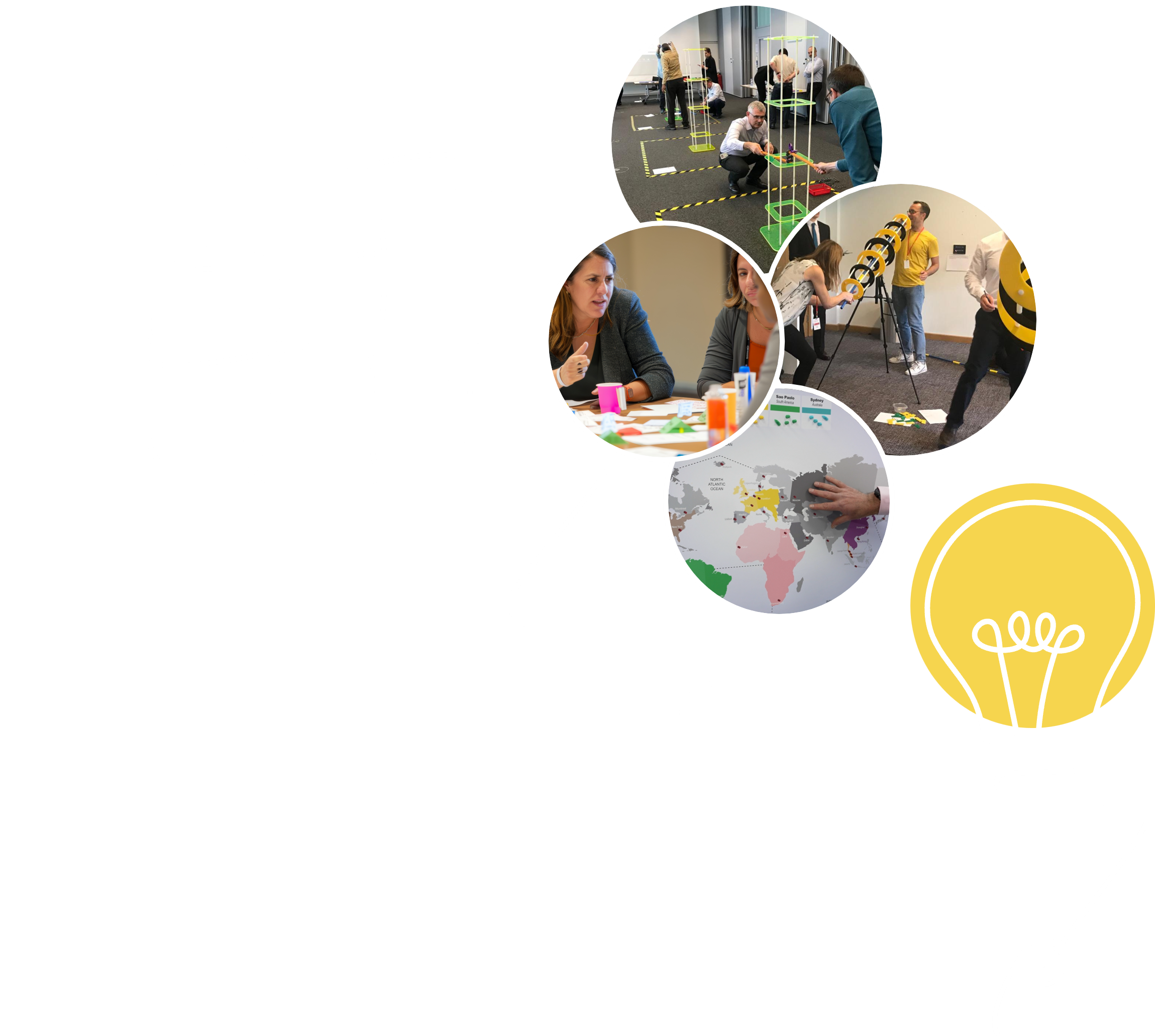
How our Strategic Thinking Simulation works…
At the beginning of the simulation, participants are grouped into teams and tasked with establishing their own business. Each team member takes on a functional role – such as strategic planning and marketing, operations management, procurement and supply chain, and financial and commercial management. As a team, they are responsible for agreeing and operationalising their strategy for the initial year ‘start-up’.
The simulation progresses through multiple rounds, each representing a ‘business year’ (each year being one-hour). During each period, teams must analyse market conditions, interpret financial data, and respond to evolving challenges. They make key decisions on scaling production, entering new markets, managing risk, and innovating operational processes, products and services. Their performance is evaluated based on typical KPIs such as profitability, customer satisfaction, operational efficiency, and long-term sustainability, however, these can be aligned to your organisational KPIs. We can also align the simulation to your company values and culture too if required.
Teams interact in a dynamic marketplace where they can negotiate deals, trade resources, and sell products or services to new markets and other teams. They learn how to collaborate, compete, and build strategic partnerships that generate value for all stakeholders. Success often depends on effective communication, negotiation skills, and the ability to identify win-win opportunities that strengthen their market position.
Although the simulation is controlled and risk-free, it realistically reflects the complexities of modern business management. Participants face challenges such as supply chain disruptions, budget constraints, shifting consumer demand, and competitive pressures. By navigating these situations collaboratively, they develop strategic thinking, problem-solving abilities, leadership skills, and a deeper understanding of how businesses operate in the real world.
A scalable solution, customisable to your needs…
Our fun and inclusive Strategic Thinking Simulation can be tailored to reflect your values and principles, your desired outcomes, and align seamlessly with your conference or away-day themes.
Based on your needs, we have versions ranging from half-day to two-days in duration.

The flexible solution that achieves a number of learning outcomes…
Demonstrate an understanding of how to run a global business...
Demonstrate an understanding of how to run a global business by making informed decisions across markets, customers, and operations in a realistic simulated environment.
Apply strategic thinking, financial acumen, and cross-functional collaboration...
Apply strategic thinking, financial acumen, and cross-functional collaboration to drive business performance and respond to changing market conditions.
Exhibit leadership behaviours and promote team alignment...
Exhibit leadership behaviours and promote team alignment by coordinating roles, guiding decision-making, and fostering effective communication within their business unit.
Use key performance indicators (KPIs) to evaluate business results...
Use key performance indicators (KPIs) to evaluate business results and link decision-making to commercial awareness and real-world business performance metrics.