




















The short version
- Teach judgement, not just policy — employees need to recognise warning signs, understand the wider impact and decide under pressure.
- Link risk to commercial outcomes — practise weighing decisions against revenue, margin, cash flow and customer performance.
- Practise, then embed — simulations let people feel the consequences of risk decisions, and follow-through makes the learning part of everyday work.
6
Elements of effective risk management training: business context, early assessment, commercial impact, ownership and escalation, experiential practice, and embedding it in everyday work.
Source: MDA Training
Risk management training for employees: what should it include?
Imagine a procurement manager discovering that a critical supplier may miss a delivery. The immediate concern is operational, but the consequences could extend to production schedules, customer commitments, cash flow and reputation.
How that manager responds depends on more than knowing the organisation’s risk policy. They need to recognise the warning signs, understand the wider implications, involve the right colleagues and make a sound decision under pressure.
This is where effective risk management training for employees makes a difference. It develops the judgement and behaviours people need to manage uncertainty as part of their everyday work.
The World Economic Forum’s Global Risks Report 2026 highlights the growing interconnectedness of economic, geopolitical and operational risks. For organisations, this reinforces the importance of employees understanding how decisions in one function can affect the wider business.
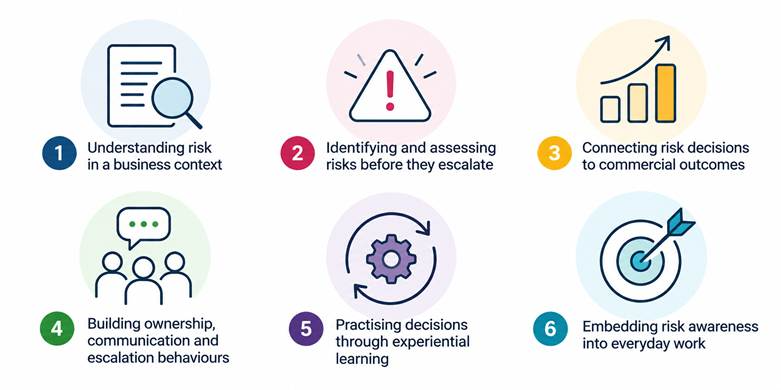
1. Understanding risk in a business context
Training should begin with a shared understanding of risk and its relationship with organisational objectives.
Employees need to recognise different sources of exposure, including operational disruption, financial uncertainty, regulatory requirements, supply chain dependencies, and reputational concerns.
They should also understand risk appetite, which defines the nature and level of risk an organisation is prepared to accept in pursuit of its objectives.
ISO 31000 provides an established framework for integrating risk management into organisational decision making, planning and culture (ISO, 2018).
The practical learning question is simple: when is a risk acceptable, and when does it require further action?
Assessment techniques
Risk registers, FMEA, bow tie analysis and root cause analysis, the tools that help employees assess risk before it escalates…
Source: MDA Training
Lines in the Three Lines Model
Distinct but connected responsibilities for managing risk, providing oversight and delivering assurance…
Source: Institute of Internal Auditors, 2026
2. Identifying and assessing risks before they escalate
Recognising a risk early creates more options for responding effectively.
Risk management training should help employees distinguish between causes, potential events and consequences. It should also introduce practical assessment techniques, including:
· Risk registers: documenting significant risks, priorities, controls and ownership.
· Failure mode and effects analysis (FMEA): examining how processes might fail and what those failures could mean.
· Bow tie analysis: connecting potential causes with preventative controls, consequences and mitigation measures.
· Root cause analysis: understanding the underlying factors contributing to recurring problems.
These tools become particularly useful when employees apply them to familiar business situations.
For example, a delayed supplier delivery could prompt teams to assess alternative suppliers, inventory exposure, customer implications and the effectiveness of existing controls.
Does the employee know the policy, or can they apply it when the supplier misses a delivery? Can they see how one decision ripples across cash flow, customers and reputation? Will they speak up, or assume someone else already has?
3. Connecting risk decisions to commercial outcomes
An important element of employee risk management training is understanding the commercial consequences of decisions.
Consider a team deciding whether to invest in additional quality checks. The expenditure may affect short term costs, while the decision could also influence rework, customer satisfaction, operational capacity and future profitability.
Employees should practise evaluating these connections using relevant measures such as revenue, margin, cash flow, cost of poor quality and customer performance.
This helps them make informed decisions within organisational priorities and acceptable risk boundaries.
Read More: https://mdatraining.com/what-does-commercial-awareness-actually-mean-for-employees/
4. Building ownership, communication and escalation behaviours
Effective risk management depends on employees knowing when to act independently, when to challenge assumptions and when to involve others.
The Institute of Internal Auditors’ updated Three Lines Model (2026) emphasises the distinct but connected responsibilities involved in managing risk, providing oversight and delivering assurance.
Training should therefore address practical behaviours: communicating concerns clearly, assigning ownership, challenging decisions constructively and following corrective actions through to completion.
A risk identified by one team may need a coordinated response from several others.
Employees benefit from practising these conversations, particularly when information is incomplete or different functions have competing priorities.
5. Practising decisions through experiential learning
Understanding risk principles is valuable. Applying them when circumstances change requires practice.
Experiential risk management training can place employees in realistic business simulations where they manage competing priorities, respond to emerging events and experience the consequences of their choices.
For example, participants might operate a simulated business across several decision cycles. They could establish a strategy, allocate resources, assess risks and respond to unexpected disruption.
Rotating responsibilities across finance, operations, commercial and supply chain functions allows participants to appreciate different perspectives.
Facilitated reviews between decision cycles help learners examine their assumptions, evaluate control effectiveness and adjust their approach.
The learning becomes especially meaningful when participants can connect their decisions with measurable commercial and operational outcomes.
See it in action
This is the thinking behind MDA’s Risk Management Simulation, where participants run a simulated business, respond to unexpected disruption, and see how their risk decisions affect commercial performance.
6. Embedding risk awareness into everyday work
Training should conclude with practical application.
Employees need opportunities to identify where risk management can become part of existing routines, including project reviews, supplier discussions, operational meetings and investment decisions.
Useful follow through activities include assigning responsibility for identified risks, agreeing escalation triggers, reviewing control effectiveness and revisiting decisions as circumstances change.
Organisations can also evaluate learning through observed behaviours, the quality of risk assessments and evidence that agreed actions have been completed.
Developing confident risk decision makers
Effective risk management training equips employees to recognise uncertainty, assess its implications and make responsible decisions with others.
At MDA Training, we design experiential learning programmes that bring business risk to life through practical activities, simulations and facilitated reflection. Our approach helps learners connect risk behaviours with commercial performance and apply their insights in the workplace.
Explore MDA Training to discuss how a tailored risk management learning experience could support your organisation.
