



















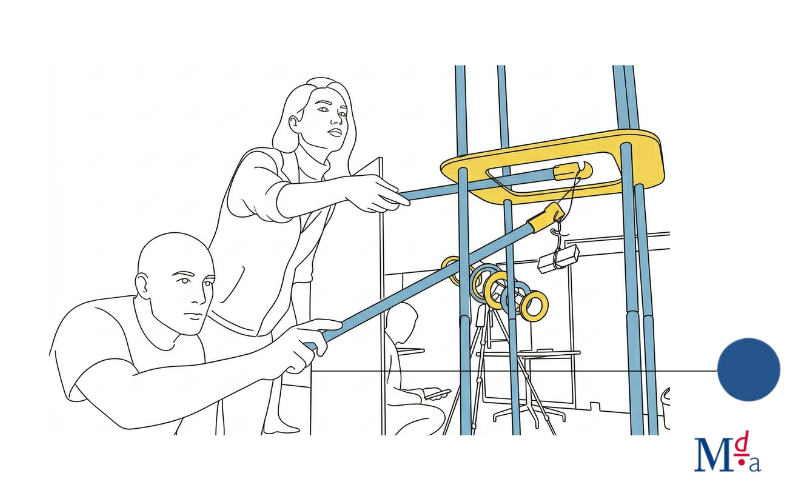
Inside a leadership simulation day: what to expect
For many HR and L&D leaders, the idea of a leadership simulation is appealing but still slightly abstract. It is easy to understand the principle. Harder, sometimes, to picture what the experience actually feels like in practice.
What happens on the day? How immersive is it? What are participants really doing? And most importantly, what do they leave with that is different from a more traditional development session?
Why leadership simulations are designed the way they are
Before stepping into the structure of the day, it is useful to understand the design philosophy.
Leadership simulations are built around one core idea. People develop leadership capability more effectively when they can practise decision-making in realistic conditions, rather than by discussing concepts.
Research on simulation-based learning shows that active engagement, decision-making and structured reflection support deeper learning, particularly for complex skills such as judgement, prioritisation and problem solving (Chernikova et al., 2024).
That is why a simulation day feels different. It is not primarily about being told what good leadership looks like. It is about experiencing the consequences of decisions in a controlled, facilitated environment.
A leadership simulation is not a workshop with an activity. It is a structured experience where leadership is practised, observed and refined.
Step 1: Setting the context and expectations
The day typically begins with a clear briefing. This is not a long theoretical introduction but a focused orientation that helps participants understand:
- The business context they are stepping into
- The objectives of the simulation
- How decisions will be made and evaluated
- What success looks like within the scenario
This stage is critical. Research suggests that clarity of purpose and relevance increases engagement and learning effectiveness, particularly in experiential settings (CIPD, 2025).
Participants are also encouraged to approach the day as they would real work. That means making decisions with incomplete information, managing time pressure, and working with others to achieve the required outcomes.
Step 2: Entering the simulation environment
Once the briefing is complete, participants move into the simulation itself.
This usually involves working in teams within a realistic business scenario. Depending on the design, this could include:
- Reviewing financial and operational information
- Making strategic and operational decisions
- Responding to changing conditions and new data
- Balancing short-term performance with longer-term priorities
- Collaborating across roles and perspectives
The environment is designed to feel credible rather than theatrical. The aim is not to entertain, but to create meaningful pressure and decision points that mirror actual leadership challenges.
Research highlights that relevance and cognitive engagement are more important than surface realism alone in driving learning outcomes (Chernikova et al., 2024).
Step 3: Decision cycles and consequences
A defining feature of a leadership simulation is the presence of decision cycles.
Participants make a set of decisions, then see the consequences of those decisions unfold. This may be through updated performance data, feedback within the scenario or facilitated discussion.
This cycle repeats multiple times throughout the day. Each round builds on the previous one, allowing participants to:
- Test different approaches
- Refine their thinking
- Experience the impact of earlier choices
- Adjust strategies in response to outcomes
This is where experiential learning becomes particularly powerful. It compresses experience. Participants can see the longer-term effects of decisions within a much shorter timeframe than in the real workplace.
In a simulation, leaders make decisions and experience the consequences quickly enough to learn from them.
Step 4: Facilitated debrief and reflection
The debrief is one of the most important parts of the day.
After each decision cycle, and especially at key points, facilitators guide structured reflection. This is not a general discussion. It is a focused exploration of:
- What decisions were made and why
- What assumptions influenced those decisions
- What worked and what did not
- How different approaches compared
- What this means for real workplace situations
Research consistently shows that debriefing plays a central role in consolidating learning in simulation based environments. Facilitator expertise and structured reflection are strongly linked to better outcomes (The impact of simulation debriefing process on learning outcomes, 2025).
This is where participants begin to connect experience to insight.
Step 5: Linking the experience to real work
A well-designed simulation does not end with the final round of decisions. It closes by helping participants translate their experience into practical actions.
This may include:
- Identifying specific behaviours to apply in their roles
- Recognising patterns in how they approach decisions
- Considering how to involve others more effectively
- Reflecting on how they use financial or commercial information
- Setting intentions for how they will act differently
CIPD guidance emphasises that learning is most effective when it is clearly linked to workplace application and supported by reflection (CIPD, 2025).
Without this step, even a strong simulation can lose impact. With it, the experience becomes a foundation for ongoing development.
What participants typically take away
While every simulation is different, participants often leave with:
- A clearer understanding of how their decisions affect business performance
- Greater confidence in navigating ambiguity and pressure
- Improved ability to balance competing priorities
- Stronger awareness of how they collaborate and influence others
- Practical insights that can be applied immediately in their role
Importantly, these outcomes are grounded in experience rather than theory. Participants have seen what happens when different approaches are taken, which makes the learning more tangible and memorable.
Now… experiencing it first-hand
For many organisations, the most useful way to understand the value of a leadership simulation is to experience one directly.
MDA Training’s leadership simulation taster day in London offers HR and L&D leaders the opportunity to step into a simulation environment, take part in decision making and experience the facilitation approach first-hand.
This allows participants to:
- Understand how simulations are structured and delivered
- Experience the level of engagement and challenge involved
- See how commercial, strategic and behavioural elements are integrated
- Assess how the approach could fit within their own leadership development strategy
Rather than relying on descriptions, the taster day provides a practical, immersive insight into what experiential leadership development looks like in action. For organisations considering this approach, understanding what happens during a simulation day can help demystify the process and clarify its value.
The most effective way to evaluate it, however, is to experience it directly. MDA Training’s leadership simulation taster day offers a practical opportunity to do exactly that, providing a clear, grounded view of how experiential learning can strengthen leadership development.
