



















Developing commercially minded partners through simulation
An immersive commercial decision-making simulation where newly promoted and aspiring partners step into the role of managing a legal matter, balancing client expectations, pricing, resourcing and profitability in a realistic law firm environment.
Audience: Newly promoted and aspiring partners
The project
A leading international law firm recognised that while its lawyers possessed exceptional technical expertise, many newly promoted and aspiring partners lacked general commercial awareness and confidence.
The firm’s leadership identified several recurring challenges:
- Limited understanding of the financial drivers of law firm profitability
- Difficulty balancing client demands with commercial objectives
- Inconsistent decision-making around pricing, staffing, and resource allocation
- A tendency to focus on legal excellence without considering wider business implications.
The firm wanted a learning solution that would move beyond traditional classroom training and allow participants to experience the commercial realities of partnership in a practical, engaging, and risk-free environment. The issue was not about turning lawyers into accountants. It was about helping them make better commercial decisions.

The solution
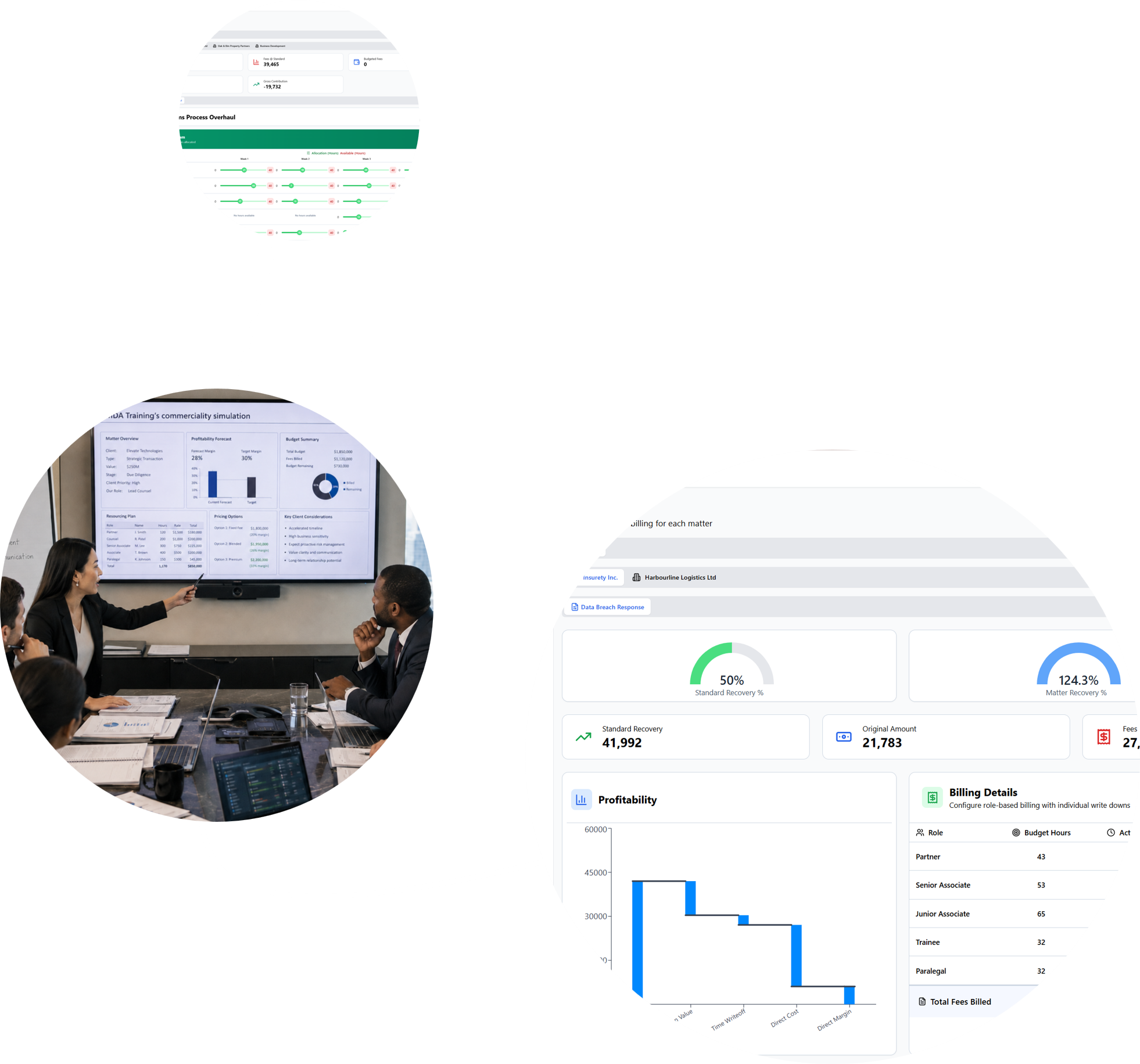
We designed a tailored commercial skills programme built around a law firm simulation. The experience gave participants a realistic view of how pricing, resourcing, utilisation, recovery, write-offs and client expectations interact across the lifecycle of a legal matter, from initial instruction through to delivery and review.
The immersive digital simulation placed participants in the role of partner responsible for managing a legal matter over four simulated years. Working individually or in teams, participants were required to make a series of interconnected commercial decisions that influenced both short-term performance and long-term profitability.
Throughout the simulation, participants managed:
- Client management and service delivery
- Staffing and resourcing decisions
- Pricing and Matter profitability
- Billing, cash recovery and working capital.
- Competitive pressures and market challenges.
As the simulation progressed, participants experienced the consequences of their decisions through evolving financial and operational results. This created a good foundation to facilitate meaningful discussions to help identify where a different approach would have improved the outcome(s), providing practical insights to take away.
In the simulation teams had to balance multiple priorities...
Teams had to decide whether to discount fees to win new business, maintain premium pricing to protect margins, or adopt alternative fee arrangements to meet client expectations.
Participants learned how leverage affects profitability by determining the optimal mix of partners, associates, and junior lawyers across client matters.
Teams navigated realistic client scenarios involving fee pressure, service expectations, and relationship management challenges.
Participants tracked key performance indicators including profitability, recovery rates, utilisation, and client satisfaction, developing a deeper understanding of how operational decisions influence financial outcomes.
To replicate the realities of legal practice, the simulation introduced market disruptions and unforeseen challenges such as competitor pricing pressure, secondment requests, and investment decisions requiring capital allocation.
The impact
By the end of the programme, participants demonstrated a significantly stronger understanding of the commercial mechanics that drive law firm performance. The simulation helped bring the economics of partnership to life, enabling participants to see how their decisions impacted profitability, resourcing, and performance. It accelerated commercial understanding in a way that classroom training simply cannot achieve.
Participants gained a practical understanding of the relationship between pricing, leverage, recovery, and profitability.
Lawyers became more confident evaluating the commercial implications of client and matter decisions, and where required, raising issues earlier.
Participants developed a broader perspective on how individual decisions contribute to firm-wide performance, and stronger conversations between legal teams, finance and partners.
The simulation helped participants interpret financial information more effectively and use commercial metrics to guide decisions.
Most importantly, participants experienced the consequences of their decisions in a realistic environment, creating stronger behavioural shifts than traditional learning methods alone.
The programme helped lawyers see commercial management as part of good client service, rather than something separate from it.
Leading professional service firms have partnered with us to deliver our unique experiential solutions….