

















Building commercial confidence in a complex manufacturing environment
A practical simulation-led programme where first and mid-level managers stepped into a realistic manufacturing business, making decisions around cost, quality, capacity and customer delivery while seeing the commercial impact of their choices.
Audience: First and mid-level managers across operations, production, engineering, supply chain and customer-facing teams
The project
A multinational manufacturing organisation supplying specialist components into industrial and engineering markets was facing increasing commercial pressure. While the business had strong technical expertise and a well-established operational footprint, rising input costs, margin pressure and evolving customer expectations meant that commercial decision-making was becoming increasingly important across its operations.
Many managers were making decisions that directly affected profitability, cash flow and operational performance, but lacked confidence in understanding the financial implications of those decisions. Different functions often focused on local priorities rather than overall business outcomes, leading to siloed decision-making and limited visibility of impacts across the wider value chain. The organisation recognised the need to strengthen financial and commercial understanding among operational managers, many of whom had been promoted for their technical expertise rather than their commercial or management capabilities.
The organisation wanted managers to:
- Better understand how their decisions affect profitability, cash and performance
- Develop greater confidence in interpreting financial and operational information
- Understand key business KPIs and management metrics
- Take a broader, end-to-end view of the value chain
- Make decisions that balance functional and organisational priorities
- Participate more confidently in commercial and performance discussions
- Understand the financial impact of operational decisions
- Build practical commercial awareness alongside technical expertise.

The solution
We delivered a two-day experiential workshop built around a tailored business simulation, supported by facilitated learning, structured reflection and practical application to participants’ live business challenges.
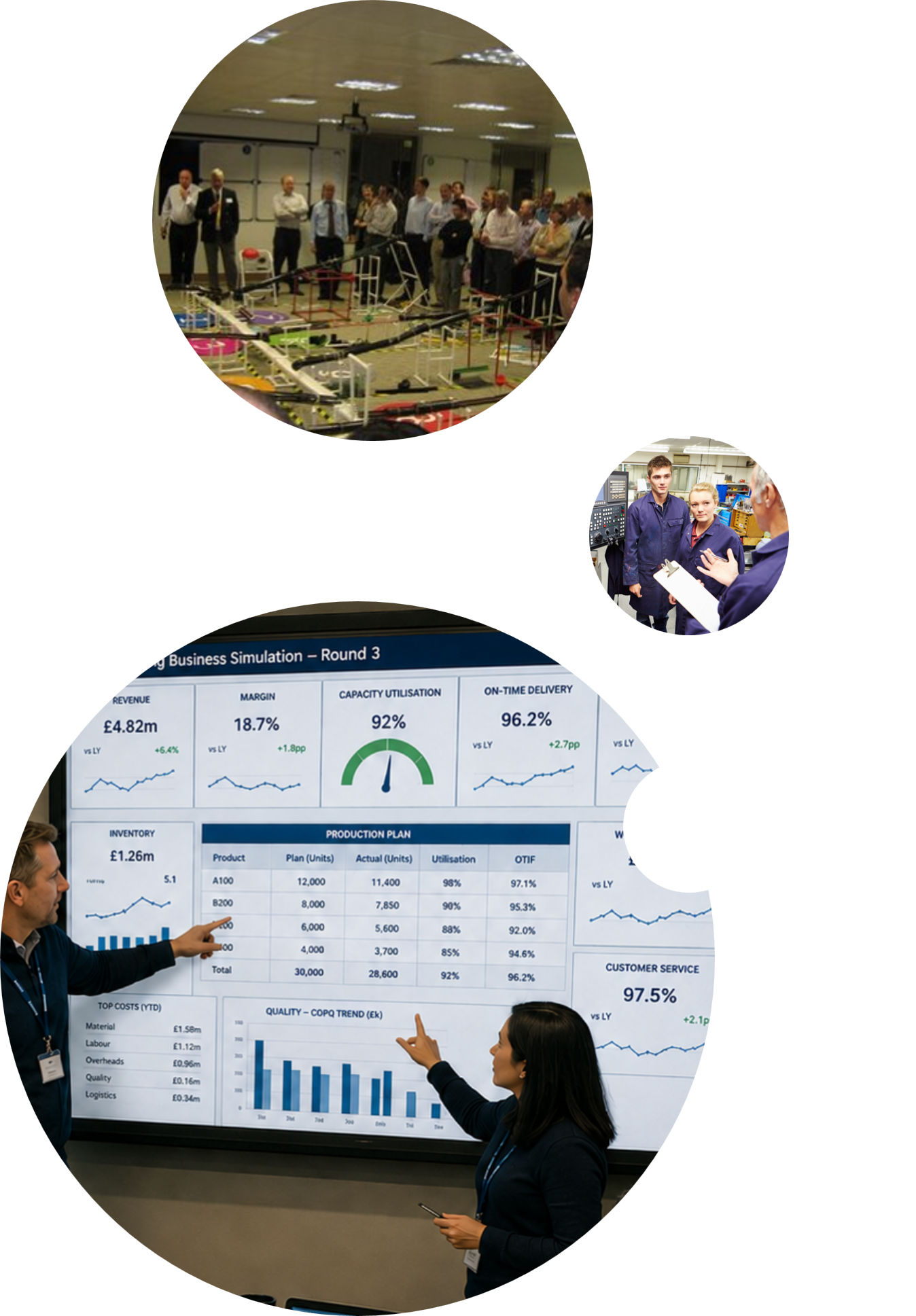
Working in teams, participants managed a simulated manufacturing business across a number of trading periods. Each team was responsible for making key commercial and operational decisions, including pricing, production planning, quality investment, inventory management, resource allocation and customer service.
Financial information was introduced progressively throughout the programme, enabling participants to build confidence in interpreting performance data in manageable learning stages. The simulation reflected real business measures, including revenue, margin, cost of poor quality, working capital and customer performance, helping participants understand how operational decisions translate into commercial outcomes.
Following each trading period, teams reviewed their results, analysed the impact of their decisions and explored alternative approaches through facilitated discussion. The learning experience was reinforced through practical financial exercises, commercial decision-making scenarios and role-based action planning to support application back in the workplace.
The outcome
The programme helped managers move beyond seeing finance as a reporting function and start using financial information as a practical tool for better decision-making. Operational leaders became more confident challenging assumptions, explaining trade-offs and making decisions that protected both customer delivery and commercial performance. As a result, participants left with a clearer understanding of how their actions contribute to organisational performance and a greater sense of accountability for delivering commercial outcomes.
Develop a stronger understanding of how day-to-day operational decisions affect financial performance and commercial results
Build greater confidence in using management information, financial data and KPIs to support decision-making
Make more effective trade-offs between cost, quality, speed and customer service
Strengthen their commercial awareness and take greater ownership of business performance
Improve collaboration and communication across functions, leading to less rework and greater operational efficiency
Hold more effective commercial conversations, using data and insight to challenge and support decisions
Apply learning directly to real business challenges and opportunities within their own roles
Make more balanced decisions that consider financial outcomes, operational performance and customer impact simultaneously
Leading organisations, past and present, have partnered with us to deliver our unique experiential solutions…